
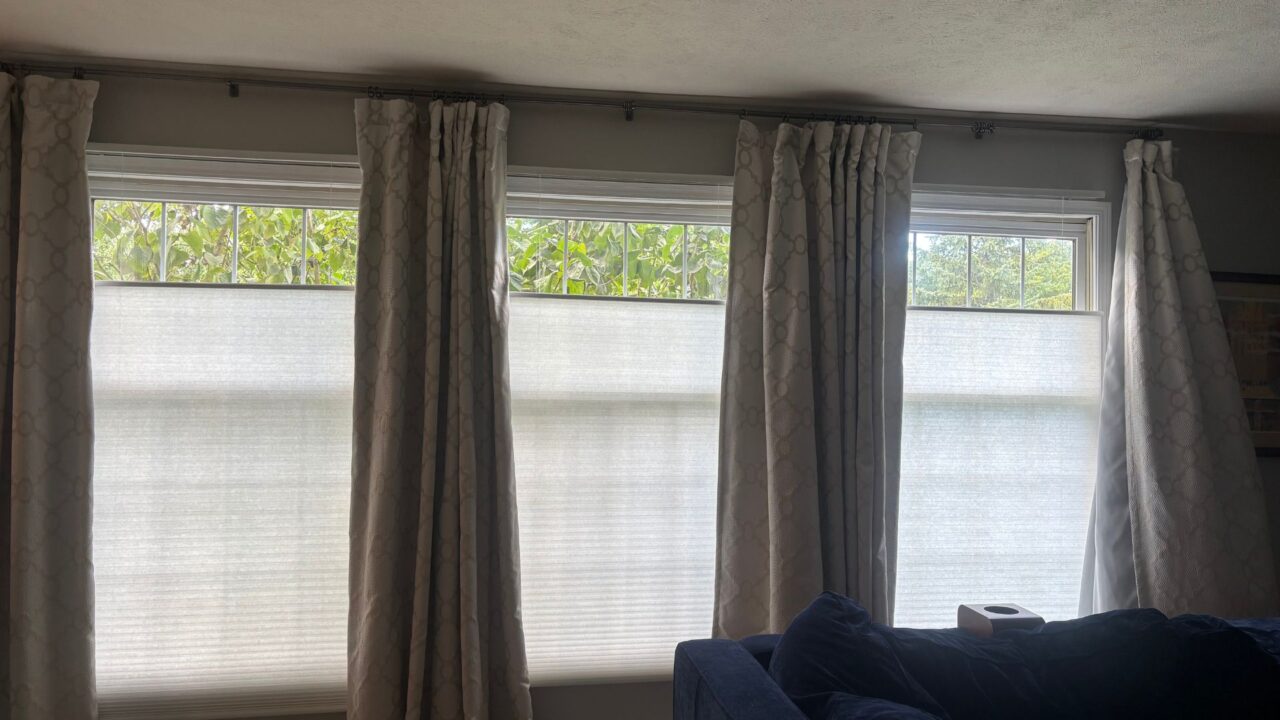
Short Answer
Draw one level line across the wall instead of measuring up from the window trim, put a bracket a few inches in from each end of the rod, and add a center support on anything longer than about 4 feet or carrying heavy drapes. Screw into wood wherever you can (the header above most windows is wood). Where there’s no wood, use anchors rated for the weight: plastic is fine for light panels, but heavy drapes need toggles or metal anchors.
This box contains affiliate links. As an Amazon Associate I earn from qualifying purchases. See the affiliate note at the bottom of this post.
🧰 What I Use
Three things that do most of the work on every curtain rod I hang:
- My 2-foot level, for the bracket line and for checking the rod once it’s up
- My stud finder, to find the wood above the window before I commit to a bracket spot
- My drill bit set, so the pilot hole matches the screw or anchor instead of being close enough
🛒 Helpful Picks
These are well-reviewed options, not my personal picks.
A curtain rod that’s crooked, sagging in the middle, or pulling out of the wall almost always comes down to three things: where the brackets were marked, what the screws went into, and whether the rod got enough support. Here’s how I hang them so they look right from across the room and are still solid years later.
If you haven’t picked your rod size and height yet, start with how to measure for blinds and curtains. This post picks up once you know where the rod is going.
Tools and Materials
- Curtain rod with its brackets, screws and finials
- Level (2-foot is plenty for most windows; a laser helps on wide ones)
- Tape measure and pencil
- Stud finder
- Drill/driver and bits
- Anchors rated for your rod and drapes (the ones in the box are usually the light-duty kind)
- Step ladder
- Painter’s tape (helpful on plaster and for marking)
Step 1: Draw One Level Line
Don’t measure up from the top of the window trim at each end and connect the dots. In a lot of older East Side homes, the trim isn’t level, the ceiling isn’t level, and sometimes neither one matches the floor. Pick your height at one end, then use the level to carry that height across to the other side. Bob Vila’s curtain rod guide suggests checking a few measurements down from the ceiling too. If the ceiling and your level line disagree by a lot, go with level, but split the difference if a dead-level rod would look obviously crooked next to a sloped ceiling.
Before you drill, step back across the room and look at the line. If there’s another window in the room, mark it at the same height now so the two rods match.
Step 2: Mark the Brackets
- End brackets: The Shade Store’s installation guide puts them roughly 4 to 6 inches in from each end of the rod, not counting finials. That leaves room for a panel or ring to sit outside the bracket so the curtain covers the edge of the window when it’s closed.
- Clear the trim: keep the brackets on flat wall, not half on the casing and half off. A bracket that rocks will loosen.
- Center support: Bob Vila recommends one for any rod longer than about 4 feet, and The Shade Store lists 3 brackets for rod-and-ring setups from 72 to 144 inches. I add one any time the rod is long, the drapes are heavy, or it’s a double rod. Put it where it won’t block a ring from sliding to the middle if you’re using a one-way draw.
Hold each bracket on the line and mark through its screw holes with a pencil. Check the bracket itself with the level while you mark, since some have a top and bottom that aren’t obvious.
Step 3: Figure Out What You’re Screwing Into
This is where most rods fail. Run the stud finder over each mark before you drill.
Wood (best)
Most window openings have a wood header across the top, and there’s usually framing on each side. If your brackets are close to the window, there’s a good chance you’ll hit wood. Drill a pilot hole a little smaller than the screw and drive the screw in snug. No anchor needed.
Drywall with no wood behind it
The Shade Store sums it up well: plastic expansion anchors work for lighter rods, but heavier drapery or double rods call for toggle bolts or self-drilling metal anchors, rated for the combined weight of the hardware and the panels. The little plastic anchors in the rod box are fine for sheers on a short rod. I don’t trust them for blackout or lined drapes that get yanked open and closed every day.
Plaster and lath
Older homes around here often have plaster. It’s harder than drywall and it can crack or crumble if you go at it fast. Put a piece of painter’s tape over the mark, drill slowly with a sharp bit, and don’t use the hammer setting. If the bit hits wood lath, a screw into the lath holds light rods well; for heavy drapes, find the framing or use a toggle sized for the wall thickness. Not sure what you’ve got? Here’s how to tell plaster from drywall.
Mounting on the trim
Screwing the brackets into the face of solid wood window casing works for lighter rods and is sometimes the only option on a window that runs close to the ceiling. Predrill so the trim doesn’t split, and keep the screws away from the trim’s edges.
Step 4: Mount the Brackets
- Drill pilot holes (or anchor holes, sized to the anchor’s directions).
- Set anchors flush with the wall where you need them.
- Screw the first end bracket on, but don’t crank it down all the way yet.
- Set the rod on that bracket, put the level on the rod, and confirm the other end bracket’s marks still line up. Adjust if needed.
- Mount the other end bracket and the center support, then tighten everything until the brackets are firm and flush. Don’t overdrive the screws. A stripped hole in drywall is a new anchor and a patch.
Step 5: Hang the Curtains and Test It
Thread the panels or rings on, set the rod in the brackets, add the finials, and tighten any set screws that lock the rod in place. Wayfair’s hanging guide notes that without set screws, the rod simply rests on the brackets, and it’ll pop out the first time someone tugs a curtain. Then open and close the curtains a few times. Watch for a bracket that shifts, a rod that dips in the middle, or a ring that catches on the center support.
Time and Difficulty
- Time: about 20 to 45 minutes per window once you have everything, longer on plaster or if you’re figuring out anchors.
- Difficulty: easy to moderate. Drywall into wood is easy. Plaster, heavy drapes, wide windows and double rods take more care.
Common Mistakes
- Measuring up from out-of-level trim instead of drawing one level line.
- Using the plastic anchors from the box for heavy drapes.
- Skipping the center support on a long rod, then living with a sag.
- Putting the end brackets right at the rod ends, so the panels can’t cover the window edges.
- Drilling plaster fast with a dull bit and blowing out a chunk of wall.
- Forgetting the set screws.
- Hanging the rod before checking that a blind’s headrail or a window crank won’t get in the way.
Safety
- Ladder: use a step ladder, not a chair, and move it instead of reaching.
- Wires and pipes: they don’t usually run across the top of a window, but they can. If your stud finder has an AC wire setting, use it, and be extra careful over a window that has an outlet or switch nearby.
- Older paint: if your home was built before 1978, the trim and walls may have lead paint. A few bracket holes make very little dust, but wipe it up with a damp paper towel instead of sweeping, and keep kids away while you work. The EPA’s lead page has more.
- Kids and cords: keep tiebacks and any blind cords out of reach, and keep cribs away from windows. While the drill’s out, it’s worth anchoring dressers and TVs too.
DIY or Call a Guy?
DIY it if it’s a standard rod over a normal window in drywall, especially if the stud finder shows wood above the window. It’s one of the easier jobs in the house.
Call someone if you’ve got plaster walls and heavy drapes, a wide window that needs a double rod with several supports, tall windows that need a big ladder, or a whole house of windows where you’d rather have everything matched and level the same day. If you’re also putting up blinds, here’s how to install window blinds so the two don’t fight each other.
Local to Euclid or Cleveland’s east side? I hang curtain rods, blinds and shades myself. See my Blinds and Curtain Installation in Euclid & Cleveland page, or text me a photo at 216-800-5883.
FAQ
Do curtain rods need to go into studs?
Not always, but wood is the strongest option. Above most windows there’s a wood header you can hit. Where there’s no wood, use anchors rated for the weight of the rod and drapes.
Why does my curtain rod sag in the middle?
Usually because it’s long or the drapes are heavy and there’s no center support. Add a center bracket, or step up to a thicker rod. Wayfair suggests 1 inch or more in diameter for heavier drapes.
Are the anchors that come with curtain rods good enough?
For light panels on a short rod in drywall, usually. For lined, blackout or heavy drapes, or a double rod, I’d swap them for toggles or metal anchors.
How do I keep the rod from falling out of the brackets?
Tighten the set screws on the brackets so the rod is locked in, not just resting there.
Can I hang a curtain rod on plaster walls?
Yes. Tape the spot, drill slowly with a sharp bit and no hammer setting, and screw into wood lath or framing where you can. Use toggles where you can’t.

Scan to join our Loyalty Program, get a free coupon for your next service, and stay up to date on our services and articles.
Affiliate Note
Some of the links in this article are affiliate links. That simply means if you choose to buy through them, I may earn a small commission at no extra cost to you. As an Amazon Associate I earn from qualifying purchases. I only recommend products I trust and would feel comfortable installing in my own home or a client’s home.
If you try something I recommended and it turns out to be anything less than a five-star experience, please let me know. I always want these recommendations to be genuinely helpful.