
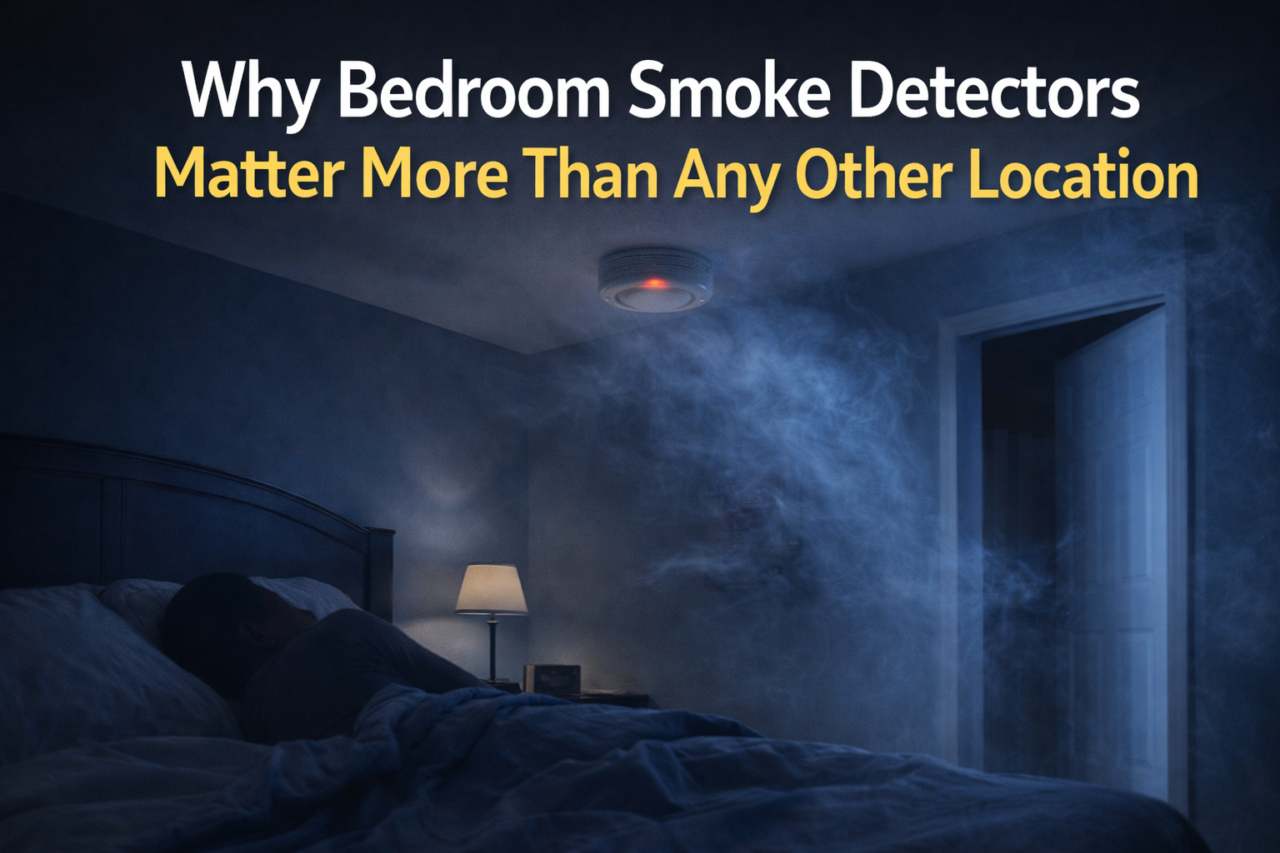
Short answer: Bedrooms matter most because most fatal house fires happen at night, while people are asleep behind closed doors. Put a smoke alarm inside every bedroom, another in the hallway outside the sleeping area, and one on every level of the home, and replace any alarm that’s more than 10 years old.
Last updated: November 2026
This box contains affiliate links. As an Amazon Associate I earn from qualifying purchases. See the affiliate note at the bottom of this post.
🧰 What I Use (Plus a Few Options)
The CO detector is the one I install. The smoke alarms are well-reviewed options rather than a specific brand I’m vouching for:
The CO detector I use on jobs. Put one outside each sleeping area, especially in homes with gas appliances or an attached garage.
Check price →
No battery swaps for the life of the alarm. Photoelectric sensors respond well to the slow, smoldering fires that are common at night.
Check price →
When one alarm sounds, they all sound, so a fire in the basement wakes someone in a closed bedroom upstairs.
Check price →
Not sure your bedrooms are covered? If you’re in Northeast Ohio, text me a photo of your detectors and I’ll tell you what they need.
Why Bedrooms Are the Most Important Location
Most fatal house fires don’t happen in the middle of the day. They happen late at night, when people are asleep and reaction time is at its lowest. Smoke doesn’t need flames to be deadly. In many cases, people are overcome by smoke long before fire reaches their room.
Bedrooms are especially vulnerable because doors are often closed and the people inside are asleep. That combination delays awareness while smoke builds. A smoke detector inside or right outside the sleeping area shortens that gap and gives a warning people can actually respond to.
That’s why the current national fire alarm code (NFPA 72) calls for smoke alarms inside every sleeping room in new homes, not just in the hallway. Older homes may have been built under earlier rules, but the same coverage is the safe target. For a full layout, see my room-by-room smoke detector placement guide.
Where Smoke Detectors Should Go Near Bedrooms
Smoke detectors work best where smoke reaches first. In most homes, that means ceiling-mounted units in and near sleeping areas rather than relying on a single detector somewhere else in the house.
- Inside each bedroom, especially in homes with children, multiple floors or older construction.
- In the hallway outside the bedrooms, within about 10 feet of the bedroom doors.
- On the ceiling whenever possible. Smoke rises. If you have to wall-mount, keep the alarm high on the wall, within 12 inches of the ceiling.
- At least 3 feet from HVAC supply vents and ceiling fan blades, which can blow smoke away from the sensor.
Stairways matter too, because they carry smoke up to the bedrooms. Here’s how stairways become smoke highways in a fire.
Common Bedroom Smoke Detector Mistakes
Relying on one detector downstairs. A detector near the kitchen is important, but it often won’t wake someone sleeping behind a closed door upstairs in time. Interconnected alarms solve this: when one sounds, they all do.
Putting alarms where they false alarm. Detectors right outside a bathroom or kitchen trip from steam and cooking, and people end up pulling the battery. A disabled detector provides zero protection.
Keeping old alarms. Smoke detectors don’t last forever. An alarm older than ten years may still chirp, test or light up while its sensor has weakened. Check the date printed on the back. If you’re weighing a replacement, here’s whether 10-year detectors are worth it.
Smoke Alarms vs. Combination Smoke and CO Alarms
Sleeping areas are also one of the most important places for carbon monoxide protection, especially in homes with gas appliances, a fireplace or an attached garage. Carbon monoxide is odorless and invisible, and early symptoms feel like fatigue or the flu, which makes nighttime exposure particularly dangerous.
A combination smoke and CO alarm covers both risks in one unit outside the bedrooms. Not every home needs combo units everywhere, but sleeping areas are one of the first places they make sense. For the differences between sensor types, see smoke detector types explained, and for CO placement, see where carbon monoxide detectors should be installed.
Bedroom Smoke Detector Maintenance That Actually Matters
- Test monthly with the test button.
- Vacuum the vents once or twice a year. Dust, pet hair and insects can interfere with the sensor.
- Replace batteries yearly in alarms with replaceable batteries. Sealed 10-year alarms don’t need battery changes: when they reach end of life, you replace the whole unit.
- Replace every smoke alarm at 10 years, no matter how fine it seems.
- Know the sounds. A single chirp every minute or so usually means a low battery or end of life. A loud, continuous pattern means smoke or CO. Get out first, then investigate.
More detail in how to maintain your smoke and carbon monoxide detectors.
Why Bedroom Detectors Come Up in Inspections
During point-of-sale and rental inspections, bedroom smoke detectors are checked for both presence and placement. Missing detectors, poor placement and outdated units are frequent problems. If you’re selling in Shaker Heights, here’s what to know about the Shaker Heights point-of-sale inspection.
Fixing these early avoids rushed, last-minute fixes. More importantly, it makes the home safer, not just compliant on paper.
When Professional Installation Makes Sense
Battery-powered alarms are an easy DIY job. Here’s whether you can install a smoke detector yourself. Hardwired, interconnected alarms are different: new circuits or wiring should be handled by a licensed electrician. A second set of eyes also helps in older homes, homes with partial coverage, and houses that have been remodeled, since layout changes often leave detectors in the wrong place.
Local to Euclid or Cleveland’s east side? I install and replace smoke and CO detectors myself. See my smoke detector installation in Euclid & Cleveland page, or text me a photo at 216-800-5883.
Bedroom Smoke Detector FAQ
Q: Do I need a smoke detector in every bedroom?
For new homes, the national fire alarm code calls for one in every sleeping room, plus one outside each sleeping area and on every level. In older homes, adding one to every bedroom is the safest choice even where it isn’t required.
Q: Should a bedroom smoke detector go on the ceiling or the wall?
The ceiling is best, away from corners and at least 3 feet from vents and fan blades. If you have to use the wall, mount it within 12 inches of the ceiling.
Q: Do I need a carbon monoxide detector near bedrooms?
If your home has any fuel-burning appliance, a fireplace or an attached garage, yes. Put one outside each sleeping area.
Q: How often should I replace bedroom smoke detectors?
Every 10 years, counted from the manufacture date printed on the back of the alarm.
The Bottom Line
If you only upgrade one part of your smoke alarm setup, make it the bedrooms. Cover every sleeping room and the hallway outside it, make sure the alarms are under 10 years old, and test them every month.

Scan to join our Loyalty Program, get a free coupon for your next service, and stay up to date on our services and articles.
Affiliate Note
Some of the links in this article are affiliate links. That simply means if you choose to buy through them, I may earn a small commission at no extra cost to you. As an Amazon Associate I earn from qualifying purchases. I only recommend products I trust and would feel comfortable installing in my own home or a client’s home.
If you try something I recommended and it turns out to be anything less than a five-star experience, please let me know. I always want these recommendations to be genuinely helpful.