
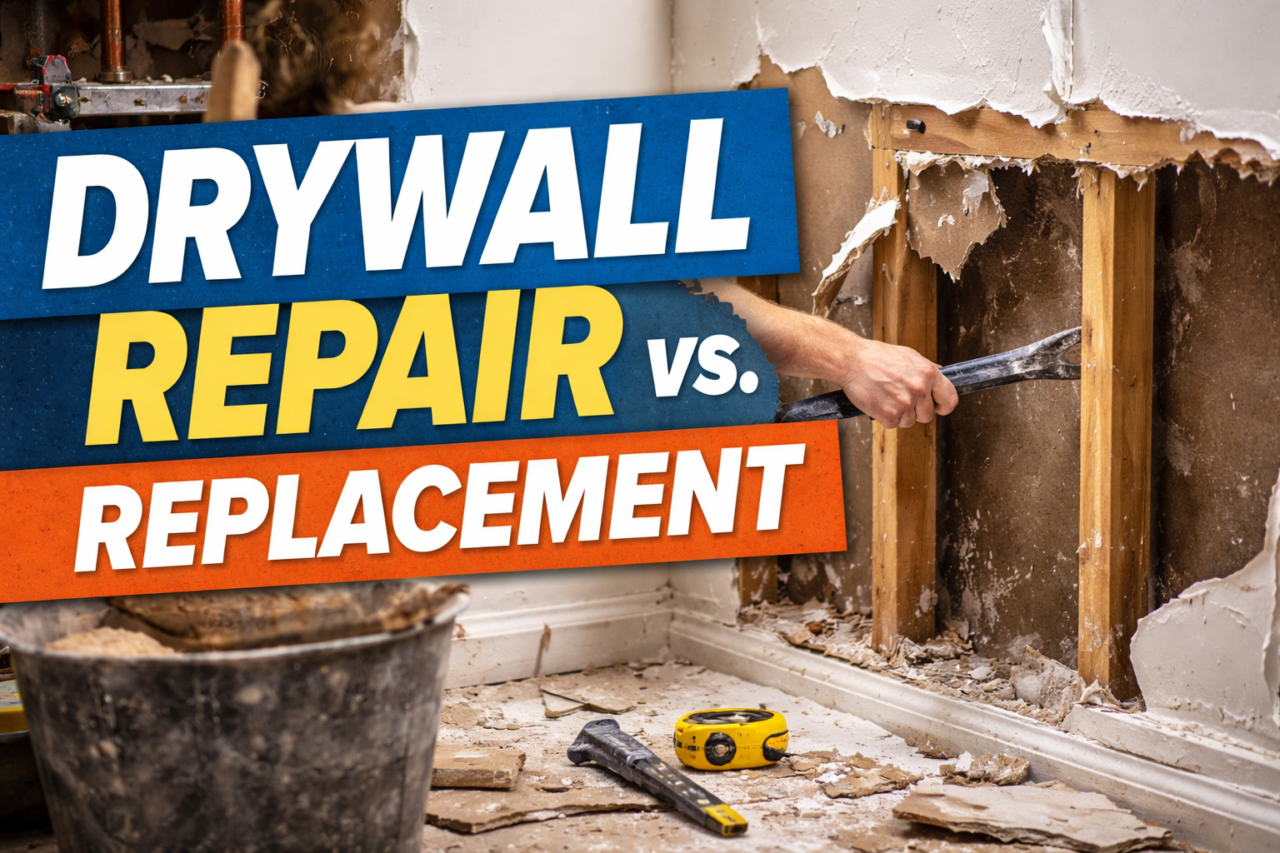
Drywall damage is one of the most common issues homeowners face. Holes from anchors, nail pops, water stains, and cracks all raise the same question: should you repair the drywall or replace the entire sheet?
The answer depends on the extent of the damage, the structural condition of the drywall, and whether moisture or framing issues are involved. In many cases drywall can be repaired quickly, but sometimes replacement is the smarter long-term solution.
Short Answer
Repair drywall when:
-
The damage is small or localized
-
The drywall is still structurally secure
-
There is no ongoing moisture issue
-
The framing behind it is solid
Replace drywall when:
-
Large sections are damaged
-
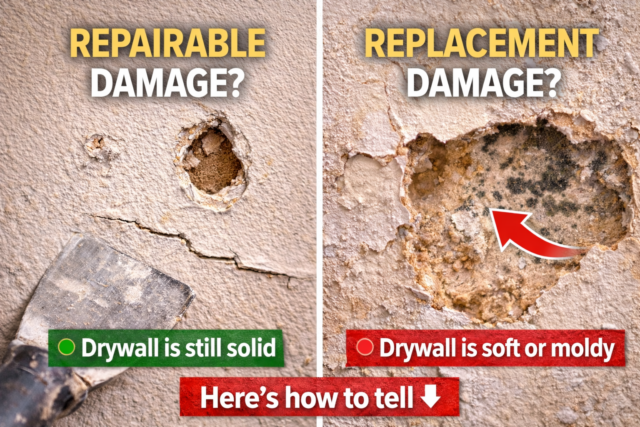
The drywall is soft, moldy, or crumbling
-
Multiple repairs would cost more than new panels
Most drywall damage in homes can be repaired. Full replacement is less common than people think.
Now let’s break down when repair makes sense and when replacement is the smarter move.
What Counts as “Repairable” Drywall Damage?
Drywall is more forgiving than most homeowners realize.
You can usually repair:
-
Nail pops
-
Small holes from anchors or screws
-
Medium holes from doorknobs
-
Cracks at seams
-
Minor corner damage
-
Small water stains (if dry and stable)
If the drywall panel is still firmly attached to the studs and not deteriorating, it is often repairable.
When Repair Is the Better Choice
1. Small Holes and Dents
Small holes under a few inches are straightforward repairs.
Examples:
-
Picture hanger holes
-
Door handle impact dents
-
Minor accidental damage
These can be filled, sanded, primed, and painted with no need to remove the panel.
Replacing an entire sheet for a small hole is unnecessary.
How to Fix a Small Hole ( The Right Way)
2. Nail Pops and Fastener Issues
If the drywall is secure and only the fasteners are failing, repair is the correct move.
The fix involves:
-
Driving a new screw into the stud
-
Resetting or removing the old fastener
-
Mudding and finishing
There is no reason to remove the whole sheet.
See our article on how to fix nail pops.
3. Isolated Water Damage That Has Fully Dried
This is where people get nervous.
If:
-
The leak has been fixed
-
The drywall is dry
-
The panel is not soft or crumbling
-
There is no mold growth
Then you may only need to:
-
Scrape
-
Seal with stain-blocking primer
-
Repaint
However, if the drywall feels spongy or has lost integrity, that is a replacement scenario.
4. Cracked Seams or Joint Tape Issues
Cracks along seams often look worse than they are.
If the drywall itself is intact, you can:
-
Remove loose tape
-
Reapply tape and compound
-
Feather and repaint
No need to replace panels unless the board has shifted or broken.
When You Should Replace Drywall
There are clear situations where repair is not enough.
1. Large Sections of Water Damage
If drywall has:
-
Swelled
-
Crumbled
-
Delaminated
-
Mold growth
-
Ongoing moisture
It needs to be cut out and replaced.
Drywall is gypsum sandwiched between paper. Once the core breaks down, it cannot be restored.
2. Mold Inside the Panel
Surface stains can sometimes be sealed.
But if mold is embedded into the drywall core, replacement is safer.
Cut it out.
Fix the moisture source.
Install new drywall.
3. Structural Movement or Framing Problems
If you see:
-
Long diagonal cracks
-
Repeated seam failures
-
Multiple fasteners popping in the same area
There may be framing movement behind the drywall.
In those cases, replacing the drywall alone will not solve the problem unless the framing issue is addressed.
4. Extensive Damage Across One Panel
If more than 40 to 50 percent of a sheet is damaged, it is often more efficient to replace the full panel.
Reasons:
-
Less patching time
-
Cleaner finish
-
Fewer visible transitions
-
Stronger long-term result
Sometimes replacement is actually faster and cleaner than patching multiple areas.
Does your wall need a full panel replacement?
Cost Considerations: Repair vs Replace
Repair is usually cheaper when damage is isolated.
Replacement becomes cost-effective when:
-
Labor to patch multiple areas adds up
-
The finish would look uneven
-
The drywall has compromised integrity
For homeowners doing it themselves, time is also a factor.
Five small patches may take longer than installing one new sheet.
What About Texture Matching?
Texture changes the equation.
If your wall has:
-
Heavy knockdown
-
Orange peel
-
Hand-applied texture
Small repairs can be blended.
But if you must replace an entire section, texture matching becomes critical.
In some cases, full replacement of a wall section provides a more consistent final look than multiple spot patches.
Ceiling Damage: Repair or Replace?
Ceilings deserve extra caution.
If the damage is small and dry, repair is fine.
If there was:
-
A roof leak
-
A plumbing failure
-
Sagging between joists
Replacement is often safer.
Ceilings fail more visibly than walls. Sagging or soft drywall overhead is not something to ignore.
How I Decide on Jobs
In most Northeast Ohio homes, I follow this rule:
If the drywall is solid and secure, repair it.
If the drywall is compromised, replace it.
I look at:
-
Structural attachment
-
Moisture history
-
Amount of damaged area
-
Final appearance expectations
Most homeowner damage is repairable.
Most water failures require replacement.
Common Mistakes Homeowners Make
Mudding Over Soft Drywall
If the core is compromised, the repair will fail.
Ignoring the Source of Water
Fixing drywall without fixing the leak guarantees repeat damage.
Over-Patching
Sometimes replacing a 4×8 section is cleaner than patching 10 separate spots.
Tools Commonly Used for Drywall Repair
Most drywall repairs require only a few basic tools:
-
Utility knife
-
6-inch drywall knife
-
Joint compound
-
Sanding sponge or sanding screens
-
Primer and paint
If you want the exact tools I keep on my truck, here’s the full setup:
👉 My Complete Drywall Tools List
https://shoplowes.me/4qXiCjQ
Final Advice
Repair drywall when the structure is sound and the damage is limited.
Replace drywall when the integrity is compromised or the damage is widespread.
If you are unsure, cut a small inspection opening and check behind the panel. The condition of the framing and insulation often tells you what you need to know.
And if you are in Northeast Ohio and want an honest evaluation before tearing into a wall, Colin Can Help handles drywall repair and full panel replacement professionally.
Still Have Questions?
Should I repair drywall or replace it?
Repair drywall when the damage is small and the drywall is still solid, dry, and securely attached. Replace drywall when the panel is soft, crumbling, moldy, widely water damaged, or when multiple repairs would cost more than installing a new section.
How do I know if drywall damage is repairable?
Drywall damage is usually repairable if the gypsum core is firm, the paper face is not delaminating, and the sheet is still tight to the studs. Small holes, nail pops, seam cracks, and minor corner damage are all common drywall repairs.
When should you replace drywall instead of repairing it?
Replace drywall when there is widespread water damage, mold inside the panel, crumbling gypsum, sagging ceilings, or structural movement behind the drywall. If more than about half the sheet is compromised, replacement is often faster and cleaner than patching.
Is it cheaper to repair drywall or replace it?
Drywall repair is cheaper when the damage is isolated, like a single hole or a few nail pops. Drywall replacement becomes cost-effective when you have multiple damaged areas, a large water-damaged section, or a finish that would look uneven after patching.
How big of a hole can be repaired in drywall?
Small holes from nails and anchors are simple repairs. Medium holes (like doorknob damage) are usually repairable with a patch. Very large holes, repeated damage in the same area, or broken drywall around the edges often pushes the decision toward cutting out and replacing a larger section.
Can you repair water damaged drywall without replacing it?
Sometimes. If the leak is fixed, the drywall is fully dry, and the panel is still firm (not spongy), you can often scrape loose paper, seal the stain with a stain-blocking primer, and repaint. If the drywall is soft, swollen, or crumbling, it should be replaced.
What does “soft drywall” mean?
Soft drywall means the gypsum core has lost strength, usually from moisture. If you can press the surface and it dents easily, feels spongy, or the paper peels away from the core, that drywall is compromised and replacement is the safer long-term fix.
Do I need to replace drywall if there is mold?
If mold is on the surface only and the drywall is still solid, you may be able to clean and seal it. If mold has penetrated the drywall core or the paper face is breaking down, replacement is the safer option. Always fix the moisture source before repairing or replacing drywall.
Can I just mud over damaged drywall?
You can mud over minor cosmetic damage, but you should not mud over soft, wet, crumbling, or delaminating drywall. If the drywall itself is compromised, the repair will fail and the patch will crack, bubble, or fall apart.
Is it better to patch drywall or replace the whole sheet?
Patching drywall is usually better when the damage is limited. Replacing drywall is often better when you have multiple repairs on one sheet, widespread water damage, or a finish that would look patchy from many blended areas.
How much drywall should I replace if there is damage?
Cut back to clean, solid drywall that is dry and firmly attached. For water damage, that often means removing the entire softened area plus a little extra until you reach firm material. If the damaged area is large, replacing a full 4×8 section can be faster than piecing patches together.
How do I check what’s behind the drywall before I decide?
If you’re unsure, cut a small inspection opening and look for wet insulation, stained framing, mold, or signs of ongoing moisture. If the framing is solid and everything is dry, repair is often fine. If moisture or movement is present, fix that first or your drywall repair will fail.
Should I repair or replace drywall cracks?
Most drywall cracks can be repaired if the drywall is still solid. Seam cracks and tape failures typically need re-taping and feathering, not replacement. Long diagonal cracks or repeated failures can indicate structural movement, which needs to be addressed before any drywall repair will hold.
Should I repair or replace drywall in a ceiling?
Small, dry ceiling damage can often be repaired. Replace ceiling drywall when there was a major leak, the drywall is sagging, the panel feels soft, or the damage is widespread. Ceilings are less forgiving because compromised drywall can fail more visibly.
Do drywall repairs show after painting?
They can if the repair is not feathered wide enough, not sanded smooth, or not primed properly. Repairs also show when texture is not matched. A proper drywall repair includes smooth feathering, correct sanding, and primer before paint.
What’s the hardest part of drywall repair for homeowners?
The hardest part is usually the finishing: feathering seams wide enough, sanding without gouging, and matching texture so the repair disappears after paint. That’s why some homeowners choose replacement or professional repair for visible areas.
What tools do I need to repair drywall?
Most repairs only need a utility knife, drywall knife, joint compound, sanding sponge or screens, and primer and paint. If you want the exact tools I keep on my truck, here’s the full setup:
👉 My Complete Drywall Tools List
https://shoplowes.me/4qXiCjQ
When should I hire a pro for drywall repair or replacement?
Hire a pro when the damage involves ceilings, large water-damaged sections, suspected mold inside the drywall, or when you need a perfect finish in a high-visibility area. If you’re in Northeast Ohio and want an honest evaluation, Colin Can Help handles drywall repair and full panel replacement professionally.
Affiliate Note:
Some links in this article may be affiliate links. If you buy through them, I may earn a small commission at no extra cost to you. I only recommend products I use or trust. If you try one and it’s anything less than a five-star experience, please let me know.

Scan to join our Loyalty Program, get a free coupon for your next service, and stay up to date on our services and articles.
Affiliate Note
Some of the links in this article may be affiliate links. That simply means if you choose to buy through them, I may earn a small commission at no extra cost to you. I only recommend products I trust and would feel comfortable installing in my own home or a client’s home.
If you try something I recommended and it turns out to be anything less than a five-star experience, please let me know. I always want these recommendations to be genuinely helpful.