
Short Answer: You Need Both
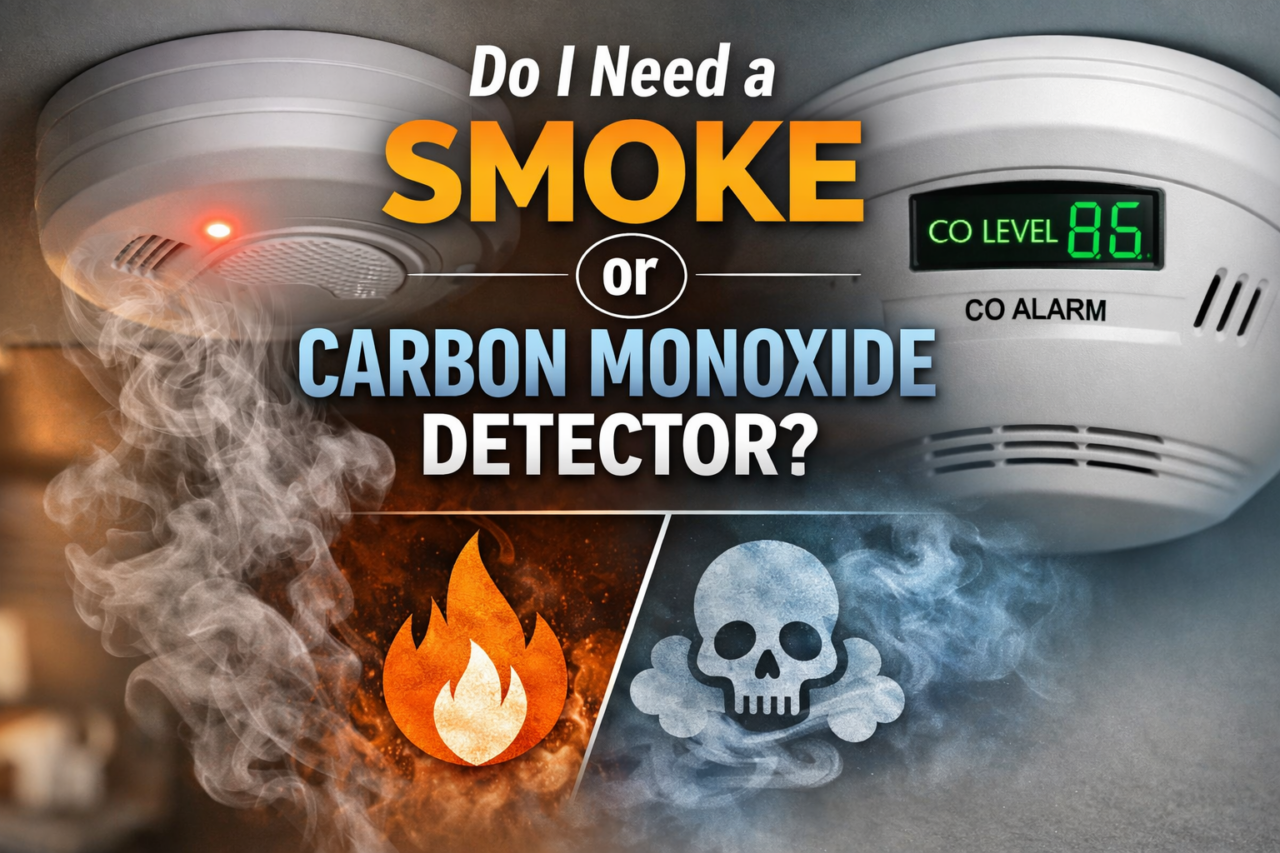
You need both a smoke detector and a carbon monoxide detector in your home. Smoke detectors warn you about fires, while carbon monoxide detectors alert you to a colorless, odorless gas that can be deadly. Together, they give you full coverage for two very different dangers.
Below I’ll show you which detectors I install in client homes, where to put them, and how to choose the right models so you can protect your family with confidence.
See my recommended smoke and CO detectors at Lowe’s. These are the same alarms I pick up on my way to all my Northeast Ohio jobs.
Understanding Smoke Detectors
Smoke detectors are designed to sense smoke particles in the air and alert you to a potential fire. They’re your first line of defense when something starts to burn, especially while you’re sleeping.
There are two common technologies: ionization (better for fast, flaming fires) and photoelectric (better for slow, smoldering fires). Many modern alarms combine both to give you more complete coverage.
For a deeper dive into placement and wiring, check out my guide on the Importance of Proper Smoke Detector Installation.
Understanding Carbon Monoxide Detectors
Carbon monoxide (CO) is a colorless, odorless gas produced by fuel‑burning appliances like furnaces, water heaters, fireplaces, and gas stoves. A carbon monoxide detector measures the concentration of CO in the air and sounds an alarm before levels become dangerous.
Even low levels of CO can make you feel sick, and higher levels can be deadly, especially at night when you’re asleep and less likely to notice symptoms. That’s why CO detectors are essential if you have any fuel‑burning appliances, an attached garage, or a fireplace.
If you want more detail on picking the right type for your home, read my guide: What Carbon Monoxide Detector Do You Need For Your Home?. For cold‑weather risks, I also recommend my Winter Carbon Monoxide Safety Guide.
Where Should Smoke and Carbon Monoxide Detectors Be Installed?
To get full coverage, you need detectors in the right places. In general:
-
Smoke detectors belong on the ceiling or high on the wall, outside each sleeping area, inside every bedroom, and on every level of your home (including the basement).
-
Carbon monoxide detectors should be near sleeping areas and on every level with fuel‑burning appliances or an attached garage.
-
Combination smoke and CO detectors can be useful in hallways or smaller homes, but I still like dedicated CO detectors near bedrooms and near major fuel‑burning appliances.
If you’re unsure whether your current setup is enough, my article on the Importance of Proper Smoke Detector Installation explains common mistakes I see in client homes.
Find the Right Detectors for Your Home
Not all alarms are created equal. Here are the main types I routinely recommend to homeowners, based on room and use‑case:
-
Bedroom smoke alarm: A basic battery‑powered or hardwired smoke alarm for each bedroom, so you’re alerted quickly if a fire starts while you sleep.
-
Hallway and main‑area smoke alarm: Hardwired, interconnected smoke alarms in hallways and on each level so if one goes off, they all go off. This gives your family more time to react.
-
Plug‑in CO detector with battery backup: Ideal for hallways near bedrooms or near a furnace or water heater. The battery backup keeps it working during power outages.
-
Combination smoke and CO alarm: Great for smaller spaces, hallways, or spots where you don’t want to mount multiple units. These can simplify things while still offering good protection.
When I’m choosing detectors for a client, I look for features like long‑life (10‑year) batteries, interconnect capability, digital CO readouts, and clear audible voice alerts.
You can browse smoke and carbon monoxide detectors I recommend here (including models with 10‑year batteries and digital displays):
Shop my recommended smoke and CO detectors at Lowe’s.
How Many Detectors Do You Need?
Every home is different, but here’s a simple starting point:
-
At least one smoke detector inside every bedroom.
-
At least one smoke detector outside each sleeping area.
-
At least one smoke detector on every level of your home, including the basement.
-
At least one carbon monoxide detector on every level with sleeping areas or fuel‑burning appliances.
In larger homes or homes with multiple fuel‑burning appliances, you may need more. For a detailed explanation, see my post on How Many Smoke Detectors Do You Need in Your Home? if you have one, or include this logic in your FAQ.
If installing and planning all of this feels overwhelming, you can always book a handyman visit and I’ll take care of it for you (link “book a handyman visit” to your handyman/services page).
Maintenance and Replacement
Even the best detectors won’t help you if they’re not maintained. You should:
-
Test your smoke and CO detectors at least once a month.
-
Replace batteries at least once a year (or as soon as the low‑battery chirp starts).
-
Replace the entire detector every 7–10 years, depending on the manufacturer’s instructions.
I cover a simple testing schedule and why June is a great month to check your devices in my article Why June Is a Good Month to Test Smoke and CO Detectors (link to that article).
Quick Smoke and CO Safety Checklist
Use this quick checklist to see how your home stacks up:
-
Smoke detectors inside every bedroom
-
Smoke detectors outside each sleeping area
-
Smoke detectors on every level, including the basement
-
CO detectors on each level with sleeping areas or fuel‑burning appliances
-
Detectors tested in the last month
-
Batteries replaced in the last year (or 10‑year batteries installed)
-
All detectors less than 10 years old
If you can’t check off most of this list, it’s time to update your alarms.
More Home Safety Guides
If you found this helpful, you might also like:
These guides go deeper into specific scenarios I see all the time in Northeast Ohio homes.
Need Help Installing Detectors in Northeast Ohio?
If you’d rather have a professional handle the install, testing, and placement, call Colin Can Help to take care of everything for you. We serve Cleveland, Euclid, and surrounding Northeast Ohio communities.
We can help you:
-
Choose the right smoke and carbon monoxide detectors for your home
-
Install and wire new alarms or replace outdated units
-
Test everything so you know your system is working correctly

Scan to join our Loyalty Program, get a free coupon for your next service, and stay up to date on our services and articles.
Affiliate Note
Some of the links in this article may be affiliate links. That simply means if you choose to buy through them, I may earn a small commission at no extra cost to you. I only recommend products I trust and would feel comfortable installing in my own home or a client’s home.
If you try something I recommended and it turns out to be anything less than a five-star experience, please let me know. I always want these recommendations to be genuinely helpful.