
Short Answer:
Not if you want it to look good.
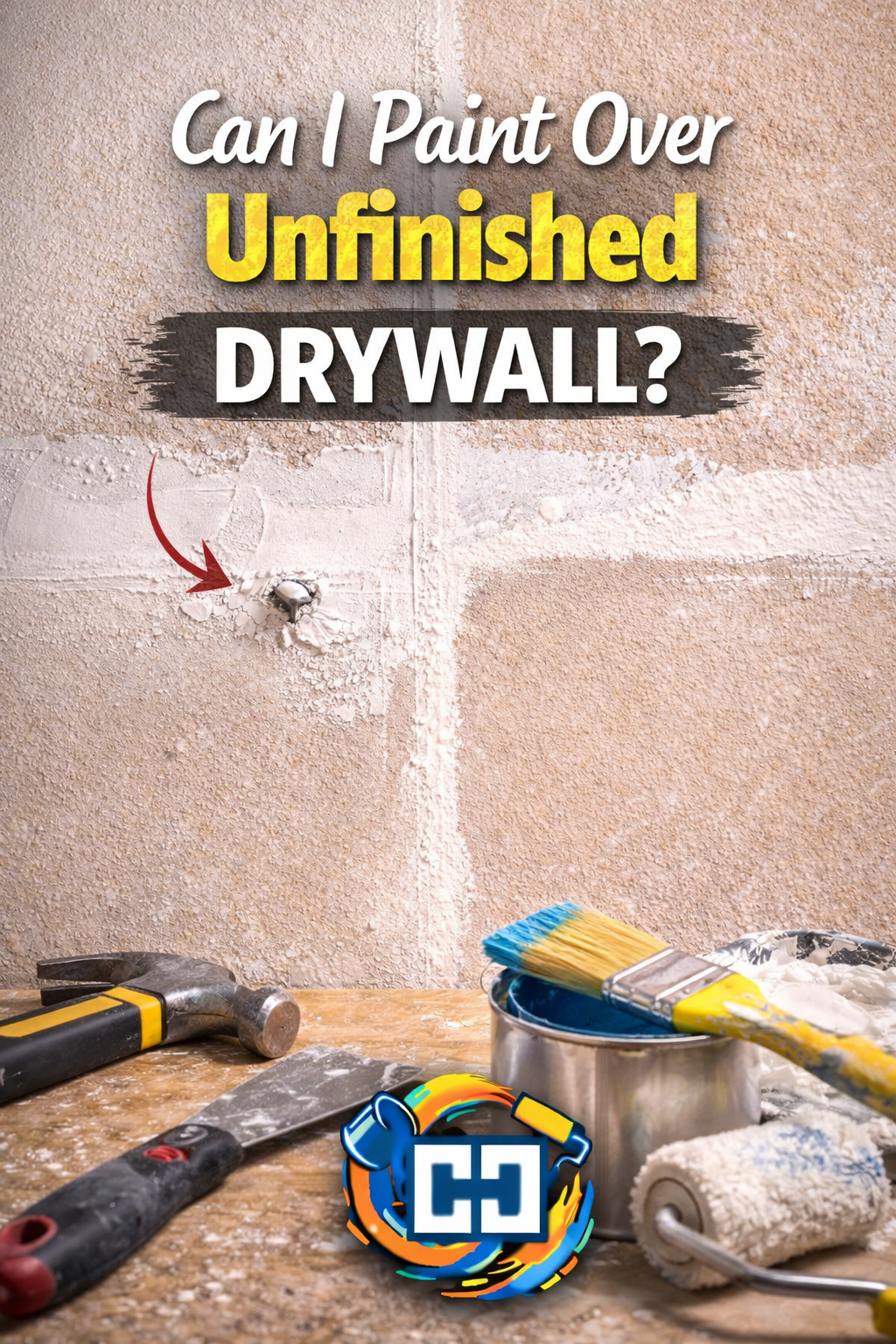
You should not paint over unfinished drywall.
Bare drywall and exposed joint compound must be:
- Fully finished
- Sanded smooth
- Primed
If you paint directly over unfinished drywall, you will get uneven absorption, flashing, visible seams, and a rough finish.
Paint is not a substitute for proper drywall finishing.
Now let’s break down what “unfinished” really means and what happens if you skip steps.
What Is Unfinished Drywall?
Unfinished drywall usually means one of three things:
- Bare drywall panels with no mud
- Taped seams but no final coats
- Sanded patches with no primer
Each of those requires prep before paint.
If you skip the finishing stage, the wall will look patchy and uneven under light.
What Happens If I Paint Bare Drywall?
Bare drywall absorbs paint unevenly.
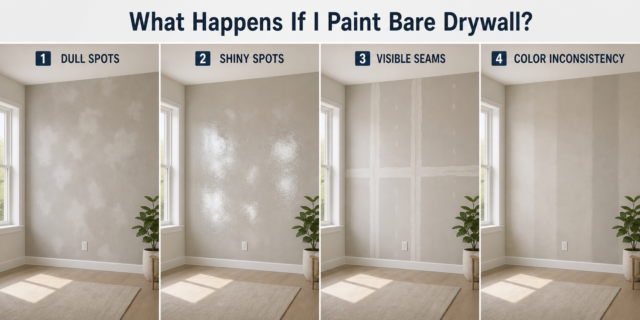
You will see:
- Dull spots
- Shiny spots
- Visible seams
- Color inconsistency
The paper face of drywall absorbs differently than joint compound.
Paint alone does not seal that difference.
Primer is required to create uniform absorption.
If your seams are already showing through paint, read:
Drywall Seam Cracks: Why They Happen and How to Fix Them
What Happens If I Paint Over Joint Compound Without Primer?
This causes flashing.
Flashing is when patched areas look different from the surrounding wall even though they are the same color.
Joint compound is porous.
Paint soaks into it more aggressively.
The result is uneven sheen.
Primer seals the surface so paint sits evenly across the entire wall.
Do I Need to Finish All Coats Before Painting?
Yes.
Most drywall requires:
- First coat to embed tape
- Second coat to widen
- Third coat to feather
Then sanding.
Then primer.
Painting before final sanding or feathering guarantees visible seams.
For the mudding coats, use a pre-mixed all-purpose joint compound like SHEETROCK Brand All-Purpose Joint Compound at Lowe’s to get consistent results across all three coats.
If you are unsure about proper mudding steps, read:
Spackle vs Joint Compound: Which One Should You Use?
Can I Paint Over Taped Seams Only?
Technically yes, but it will look unfinished.
You will see ridges and joint lines.
Tape must be fully covered and feathered.
Paint highlights imperfections.
It does not hide them.
Do I Always Need Primer on New Drywall?
Yes.
New drywall always needs primer.
Even if the surface looks uniform.
Primer:
- Seals porous surfaces
- Improves paint adhesion
- Reduces flashing
- Creates uniform sheen
Skipping primer is one of the most common DIY mistakes I see.
What Type of Primer Should I Use?
Use a quality drywall primer or PVA primer for new drywall.
Do not use regular wall paint as primer.
Primer is designed to seal the surface properly.
For new drywall, a PVA drywall primer like Zinsser PVA Drywall Primer at Lowe’s is specifically formulated to seal raw gypsum and joint compound before your finish coats.
Once primed, you can apply your finish coats of paint.
Why Does My New Drywall Look Blotchy After Painting?
Most likely causes:
No primer
Insufficient sanding
Poor feathering
Painting too soon after mud dried
If drywall mud was not fully dry before priming or painting, problems can show up later.
If dry time has been an issue, read:
How Long Does Joint Compound Take to Dry? Spackle vs Joint Compound
Can I Get Away With It in a Garage or Basement?
You can.
But it will still look unfinished.
In utility spaces, some homeowners skip full finishing.
That is a cosmetic choice.
Just understand that:
Bare drywall stains easily.
It absorbs moisture more readily.
It does not clean well.
Primer at minimum is still recommended.
What Is the Correct Order Before Painting?
Here is the proper sequence:
Finish mudding
Sand smooth
Clean dust
Prime entire surface
Paint
Skipping any step reduces quality.
For large wall areas, a Gator Pole Sander at Lowe’s makes the sanding step much faster and more consistent, especially on ceilings and tall walls.
If sanding has been messy for you, read:
What’s the Right Grit Sandpaper for Drywall Repairs?
Final Advice
If you are asking can I paint over unfinished drywall, the honest answer is:
You can.
But you should not.
Paint is not a shortcut for proper finishing.
Take the extra day to sand and prime.
It is much easier than repainting later because seams and flashing showed through.
And if you are in Northeast Ohio and want drywall finished and painted properly the first time, Colin Can Help handles drywall repair and finishing professionally.
Still Have Unanswered Questions?
Can I Paint Drywall Without Primer?
No.
Paint alone will not properly seal new drywall or joint compound.
Without primer, you will get flashing, uneven sheen, and inconsistent absorption.
Even paint-and-primer-in-one products do not replace true drywall primer on raw gypsum.
Can I Paint Drywall After Just One Coat of Mud?
You should not.
One coat of joint compound only embeds tape.
It does not feather edges wide enough to hide seams.
Painting after one coat guarantees visible lines under certain lighting angles.
What Happens If I Do Not Prime New Drywall?
If you skip primer:
-
The wall absorbs paint unevenly
-
Patched areas look dull or shiny
-
Seams show under light
-
You may need extra paint coats
Primer is cheaper than repainting.
Can I Spot Prime Instead of Priming the Whole Wall?
For small repairs, yes.
For new drywall installation, no.
Spot priming can still cause sheen differences between primed and unprimed areas.
Full-surface priming creates uniform results.
Can I Paint Drywall With Dust Still on It?
No.
Drywall dust prevents proper paint adhesion.
It can cause:
-
Rough texture
-
Peeling
-
Poor bonding
-
Visible debris in the finish
Always wipe or vacuum walls before priming.
How Long After Sanding Drywall Can I Paint?
Immediately after cleaning dust — as long as the joint compound is fully dry.
If the mud is still curing internally, paint can trap moisture and cause flashing or bubbling later.
Can I Paint Unfinished Drywall in a Garage or Basement?
You can, but it will always look incomplete.
Unfinished drywall:
-
Stains easily
-
Absorbs moisture
-
Is difficult to clean
At minimum, apply primer to seal it.
Why Does My Drywall Look Blotchy Even After Painting?
Common causes:
-
No primer
-
Uneven sanding
-
Poor feathering
-
Different paint sheens over patches
-
Painting before mud fully dried
Blotchy walls almost always trace back to surface prep issues.
Can I Fix Flashing Without Repainting the Entire Wall?
Sometimes.
Light flashing can be reduced by:
-
Lightly sanding
-
Applying a sealing primer over the entire surface
-
Repainting the full wall corner to corner
Spot repainting rarely blends well.
Is Paint and Primer in One Good Enough for New Drywall?
No.
Paint and primer in one is designed for previously painted surfaces.
New drywall requires a dedicated PVA primer to properly seal raw gypsum and joint compound.
Affiliate Note:
Some links in this article may be affiliate links. If you buy through them, I may earn a small commission at no extra cost to you. I only recommend products I use or trust. If you try one and it’s anything less than a five-star experience, please let me know.

Scan to join our Loyalty Program, get a free coupon for your next service, and stay up to date on our services and articles.
Affiliate Note
Some of the links in this article may be affiliate links. That simply means if you choose to buy through them, I may earn a small commission at no extra cost to you. I only recommend products I trust and would feel comfortable installing in my own home or a client’s home.
If you try something I recommended and it turns out to be anything less than a five-star experience, please let me know. I always want these recommendations to be genuinely helpful.