
🔑 Key Takeaway
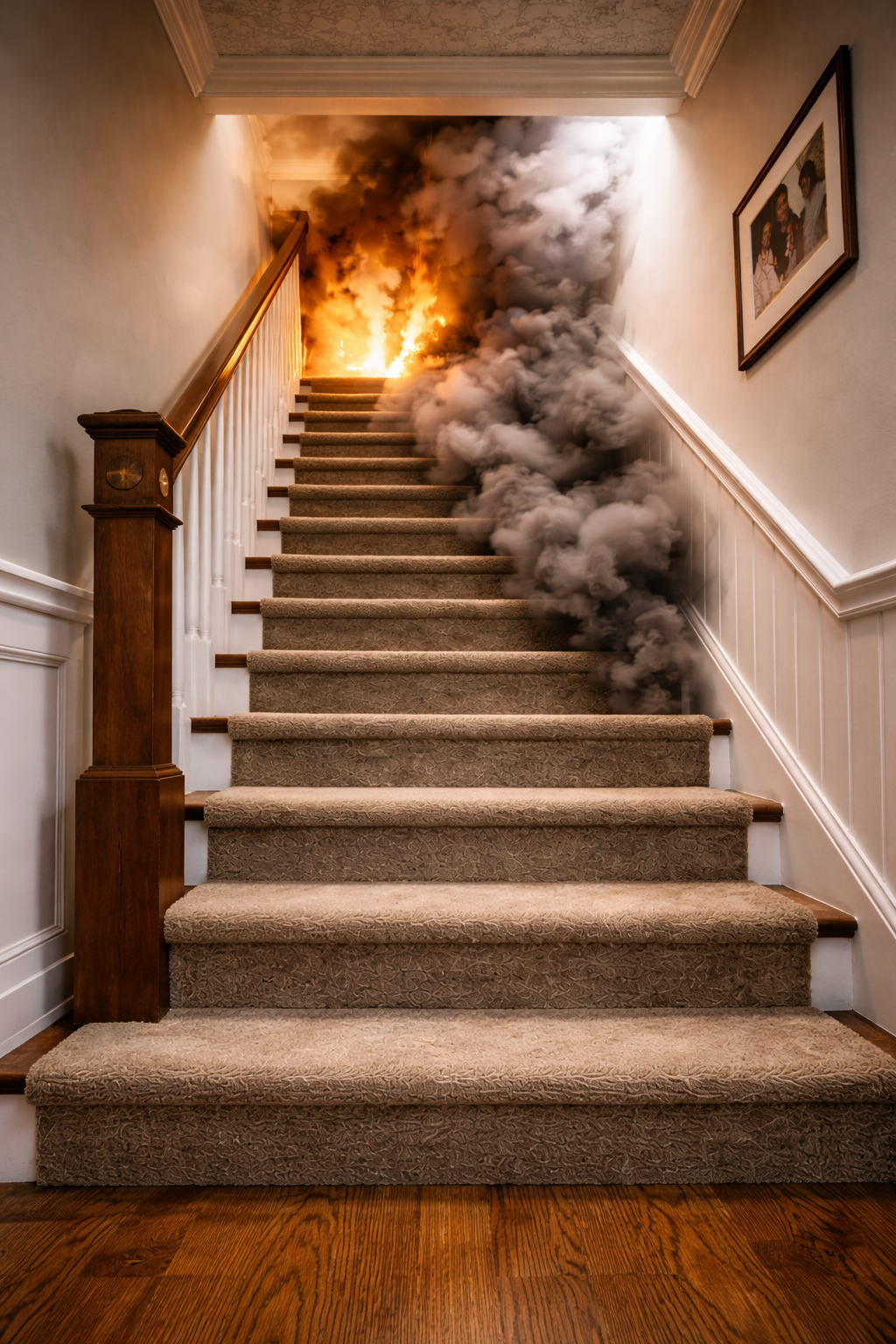
Stairways act like vertical chimneys during a fire, pulling hot, toxic smoke from lower levels and dumping it into hallways and bedrooms in minutes. That is why code bodies and safety organizations recommend at least one smoke alarm on every level, near stairways, and outside sleeping areas—not just in the room where you think a fire might start.
How Smoke Actually Moves in a House
In a typical house fire, heat makes smoke buoyant, so it rises and looks for the easiest way up—usually stairways, chases, and open ceilings. As it moves, that smoke carries toxic gases, quickly reducing visibility and breathable air long before flames reach other rooms. Fire-service training videos show that once an opening to a stairwell or upper room is created, smoke can form a fast, one-way “flow path” upward through the structure.
Because of this, many fatal home fires are primarily smoke-inhalation events, not burn injuries, and the configuration of stairs and doors plays a huge role in how survivable that smoke is.
Why Stairways Become “Smoke Highways”
Building and fire-safety guidance often describes stairways as acting like chimneys for smoke and heat. A stairwell connects low-level rooms (like basements, garages, or first-floor living areas) to upper-level hallways and bedrooms, so once smoke enters the stair space it can travel vertically with very few obstructions. Even in homes with fire-resistant stair enclosures, opening a door between a fire room and the stair can rapidly contaminate that exit with smoke.
High-rise design frequently uses stair-pressurization systems specifically to keep smoke out of stairwells because they are such critical escape paths. In houses without those systems, the only “system” you have is door control, alarm placement, and how quickly people get alerted and moving.
Basement and Lower-Level Fires: The Hidden Danger Upstairs
Many residential fires start in basements, utility rooms, or garages where furnaces, electrical panels, and stored items live. Safety bulletins emphasize that smoke from these areas can rise through the stair opening and reach upper floors long before anyone upstairs sees flames. If alarms are only installed in the basement or in a distant living room, occupants in upstairs bedrooms might not get a warning until stairways and hallways are already heavily charged with smoke.
To reduce this risk, guidance for both existing and new homes calls for smoke alarms on every level, including basements, with additional alarms outside each sleeping area and within each bedroom. That way, smoke that uses the stairway as a highway has multiple chances to trigger an alarm before it cuts off escape routes.
Where to Put Smoke Alarms Near Stairs and Hallways
Several fire-safety organizations and manufacturers align on a few key rules for alarm placement in multi-level homes.
• Put at least one smoke alarm on every level, including finished basements.
• Place alarms outside each sleeping area in hallways, plus one inside every bedroom.
• Protect stairways specifically, since they act like chimneys for smoke and heat, by locating alarms at the top and bottom of stair runs or in the adjacent hallway.
• Mount alarms on ceilings or high on walls—at least 4 inches from corners—to match how smoke rises and pools.
• Avoid placing alarms too close to windows, ducts, or bathroom doors where drafts or steam can cause problems.
For many Northeast Ohio homes, the sweet-spot locations are: one alarm at the bottom of the basement stairs, one at the top of the main stairway on the bedroom level, one in each bedroom, and another on any finished attic or third-floor level.
High-Risk Layouts: Open Concept, Split-Levels, and Older Homes
Fire-service training articles point out that wide, open staircases and vaulted ceilings can accelerate vertical smoke spread. In an open-concept foyer with a balcony or catwalk, smoke from a first-floor fire can rise unimpeded into upper levels, loading hallways and bedrooms quickly. Split-level and raised ranch homes often have stairways right at the entry door, which means a basement fire can send smoke directly up the stairs toward the main living area and sleeping spaces.
Older homes with unusual chases, additions, or partially enclosed stairs can create confusing flow paths where smoke bypasses certain rooms and suddenly appears somewhere else. In these houses, adding extra alarms in transition spaces near stairs and in longer hallways can buy more time for people to wake up, orient themselves, and make a safe exit.
Simple Upgrades Homeowners Can Do Now
Most homeowners can dramatically improve their fire safety around stairways in an afternoon.
• Install modern photoelectric or dual-sensor alarms on every level and near stairways, following guidance about height and distance from corners.
• Use interconnected alarms so that if one detects smoke—whether in the basement, by the stairs, or in a hallway—they all sound together.
• Consider long-life battery or hardwired units with backup power to avoid the “dead alarm” problem during outages.
• Add heat detection in garages or other non-living spaces where traditional smoke alarms may nuisance trip.
• Test alarms monthly and replace units according to manufacturer recommendations, typically every 8–10 years.
If you want a fast way to upgrade multiple levels at once, you can use multipacks of interconnected smoke alarms that are designed to cover several rooms and floors in one purchase.
Sponsored tip: You can find hardwired and battery-powered interconnected smoke detectors, including 3-packs and 6-packs that are ideal for multi-level homes, in the fire-safety section at Lowe’s.
When to Ask for a Professional Safety Check
Official guidance stresses that every home is a bit different, and that things like ceiling height, stairwell location, and room use matter for optimum alarm placement. If you have an older home, an unusual floorplan, or you are adding bedrooms in a basement or attic, getting a professional to walk the space and mark ideal alarm locations is a smart move.
A trained installer or handyman can also handle tasks like installing hardwired units, adding additional circuits for interconnected alarms, or coordinating smoke and carbon-monoxide protection together. That kind of small project often dovetails well with other safety upgrades like adding fire extinguishers, improving exterior lighting, or tightening up your home-maintenance checklist.
FAQ: Stairways and Smoke Spread
Why does smoke move up stairways so quickly?
Smoke from a fire is hot and buoyant, so it naturally rises and follows the path of least resistance, which in most homes is the stairwell and any connected high spaces.
Should I put a smoke alarm inside the stairwell itself?
Guidance often focuses on placing alarms at the top and bottom of stairwells or in adjacent hallways so they can detect smoke leaving the stair before it fills living spaces. In many layouts, that is more reliable than putting a single device on the stair wall.
Where are the most important places to have alarms in a two-story home with a basement?
Minimum recommendations include one alarm in the basement near the stairs, one on the first floor near the stair or main living space, one on the bedroom level hallway near the top of the stairs, and one in each bedroom.
Do closed doors really help with smoke?
Closing doors to bedrooms and stairwells can significantly slow the spread of smoke and heat, which is why “close before you doze” campaigns are common, but over time smoke can still enter if the fire continues to grow. Doors work best when combined with early detection and a clear, practiced escape plan.

Scan to join our Loyalty Program, get a free coupon for your next service, and stay up to date on our services and articles.
Affiliate Note
Some of the links in this article may be affiliate links. That simply means if you choose to buy through them, I may earn a small commission at no extra cost to you. I only recommend products I trust and would feel comfortable installing in my own home or a client’s home.
If you try something I recommended and it turns out to be anything less than a five-star experience, please let me know. I always want these recommendations to be genuinely helpful.