
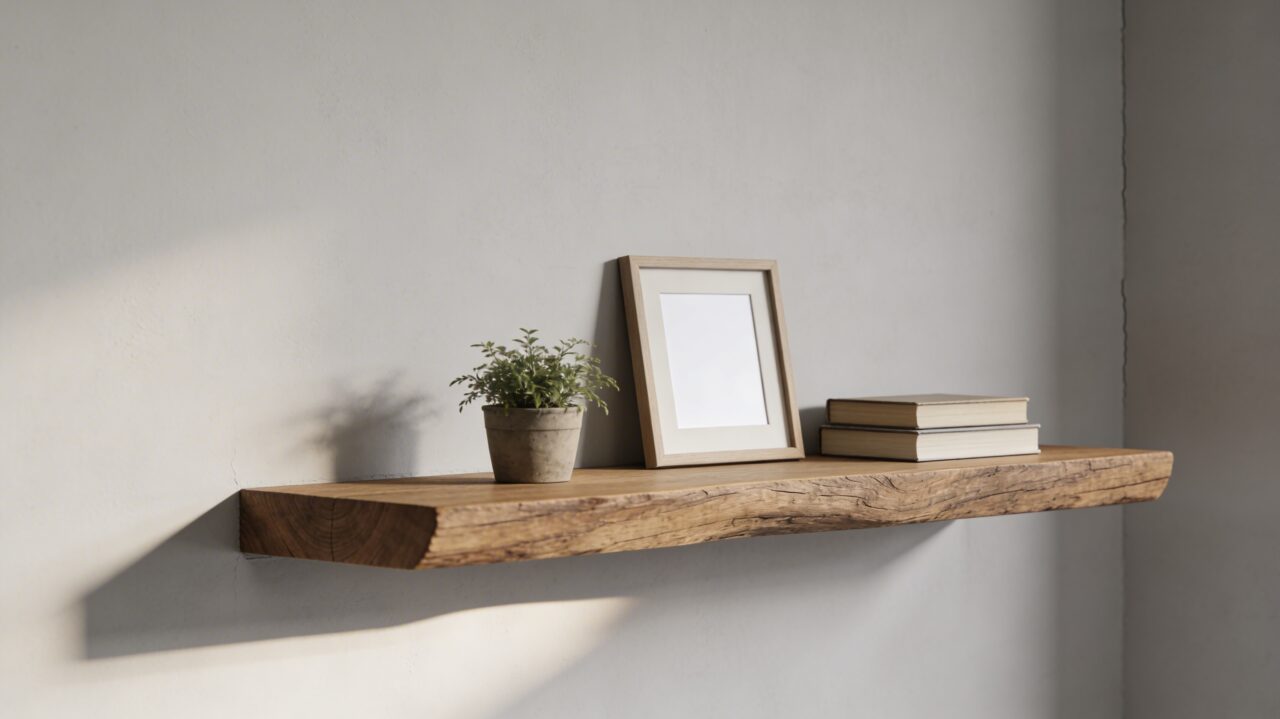
A floating shelf is one of those simple projects that can totally change how a room looks and functions, but it’s also one of the easiest ways to rip a chunk of drywall out of your wall if it’s installed wrong. In this guide, I’ll break down what a floating shelf actually is, how it works, where it makes sense in a real home, and when it’s better to call in a pro instead of guessing with anchors and a level. By the end, you’ll know if a floating shelf is right for your space and what it takes to hang one safely in your home.
What Is a Floating Shelf?
A floating shelf is a wall-mounted shelf that hides its brackets or supports, so it looks like it’s just “floating” on the wall with no visible hardware. Instead of using the typical “L” brackets you can see underneath, the support is buried inside the shelf or behind it, and the shelf slides over that support. Visually, you get a clean, modern line without any bulky hardware, which is why floating shelves show up in a lot of updated living rooms, kitchens, and bathrooms.
Even though it looks simple, a floating shelf is really a combination of a hidden bracket or rod system and a box or solid shelf that slips over that hardware. The strength of the whole setup depends on three things: the design of the bracket, how solid the shelf itself is, and how well that bracket is fastened into your wall. When people get into trouble with floating shelves, it’s almost never because the shelf looked bad—it’s because the support behind the scenes wasn’t done right.
How a Floating Shelf Works
Behind almost every floating shelf is some type of steel bracket, rod system, or cleat that attaches directly to the wall. That hardware gets screwed into the wall, ideally into wood studs, and then the shelf either slides onto those rods or hooks onto the bracket. Once the shelf is on, you’ll often find small set screws or hidden fasteners underneath or inside the shelf that lock everything together and keep it from sliding off.
From the outside, all you see is a thick, solid-looking board. Inside, though, there might be a hollow cavity that wraps around the bracket or a hidden frame that the finished face is attached to. When this is done properly, the weight from whatever you place on the shelf transfers through the shelf to the bracket and then down into the studs or strong anchors in the wall. When it’s done poorly, that weight is basically hanging off of a couple of screws in drywall, which is when you get sagging, tilting, or complete failure.
Floating Shelf vs. Regular Shelf
A regular shelf usually relies on visible support hardware. You might see metal L-brackets under the shelf, adjustable standards and clips along the wall, or a full bookcase frame sitting on the floor. These traditional setups spread weight more predictably and are often more forgiving if you overload them a bit, because the brackets are obvious and easier to size up.
A floating shelf trades that visual bulk for a cleaner look. The downside is that the shelf is more sensitive to how it’s anchored and how much weight you put on it. You can’t just throw up any old floating shelf and stack it with heavy books or dishes. If you want that minimal look without headaches, you have to treat the hidden hardware and the wall behind it as seriously as you would a heavy TV mount.
Check out my favorite shelving options available at Lowe’s
Types of Floating Shelves
Pre-Made Floating Shelf Kits
Most big-box stores and online retailers sell pre-made floating shelf kits. These usually come with a metal backplate or bar that mounts to the wall and a hollow shelf that slides onto it. The hardware might have several arms or rods that extend into the shelf, and the shelf itself often has pre-drilled holes or a channel to accept the bracket.
The big advantage of these kits is speed and convenience. You get a matched bracket and shelf that are designed to work together, the finish is already done, and you just follow the included instructions. The main downside is that you’re locked into the sizes, depths, and finishes they offer, and you still have to install the bracket correctly into studs or strong anchors. The kit can be high quality, but if the bracket is only buried in drywall, the shelf still won’t be safe.
Custom-Built Wood Floating Shelves
Custom floating shelves are typically built as a hollow wood box that slides over a hidden internal frame or cleat, or as a thick solid piece drilled to fit rods from a bracket. This is the route you take when you want an exact length for a wall, a specific wood species, or a particular thickness that pre-made kits don’t offer. It’s also the way to handle long runs of shelving in living rooms, home offices, or over a toilet where you want a built-in look.
A well-built custom floating shelf can be stronger than some cheap pre-made ones, because you can use thicker material, a better bracket design, and hit more studs. The tradeoff is that it takes more planning and more tools: accurate measuring, cutting, gluing, sanding, finishing, and then careful installation. If you want a “looks like it came with the house” effect, custom is usually the way to go.
Niche and Cabinetry Floating Shelves
Floating shelves are also common as part of cabinetry and built-ins: open shelves in a kitchen instead of some upper cabinets, shelves flanking a fireplace, or wood shelves in a niche. These shelves often carry heavier loads—like stacks of plates, bowls, or books—so the support system has to be more robust than what you’d use for a few small plants.
Here, the floating shelves might tie into blocking inside the wall, be supported by hidden steel plates, or be integrated into the cabinetry itself. They can look simple, but behind the scenes there’s usually more carpentry and structural work than most DIYers realize. This is one area where guessing with a simple kit can backfire if you expect cabinet-level performance from a decorative shelf system.
Where Floating Shelves Work Best
Living Rooms and Offices
In living rooms and home offices, floating shelves are great for displaying books, plants, photos, and small decor without adding bulky bookcases. They’re especially useful in smaller homes and apartments where floor space is tight and you want to keep the room feeling open. A few rows of properly installed floating shelves can act like a built-in media wall, a home office storage solution, or a place to display collections without clogging up the floor.
When you plan these shelves, think both about appearance and weight. Paperbacks, decor, and small frames are usually fine on typical floating shelves. Heavy hardback books, stacks of files, or big planters full of wet soil may need a more robust bracket and multiple studs to be safe.
Kitchens and Dining Areas
Floating shelves in kitchens and dining areas are popular because they keep dishes and glassware within reach and make the space feel more open than a run of upper cabinets. They’re great for everyday plates and cups, glasses, cookbooks, and attractive pantry items stored in jars. Visually, open shelves also give you a chance to style the space with a mix of practical items and decor.
The catch is that dishes and glassware are heavy, especially when you group them together. If you want floating shelves that hold stacks of plates or heavy mixing bowls, you need a system designed for that kind of load. That usually means hitting multiple studs with a serious bracket, limiting the shelf depth and length, and being honest about how much weight you’re planning to store.
Bathrooms and Bedrooms
Bathrooms and bedrooms are two areas where floating shelves can solve storage problems without crowding the room. In a bathroom, a floating shelf above the toilet can hold towels, baskets, and toiletries. In a bedroom, they can act as nightstands, book ledges, or display shelves without taking up floor space. The clean look also fits well with modern and minimalist bedroom designs.
Moisture and real-world use matter here. In bathrooms, you want finishes that can handle humidity and occasional splashes, and hardware that won’t rust. Overloading a narrow bathroom shelf with a giant plant or a stack of heavy towels can push even a decent setup past its limits. In bedrooms, remember that a shelf used as a nightstand might see more bumping, leaning, and stacking than a purely decorative shelf.
How Much Weight Can a Floating Shelf Hold?
What Determines Weight Capacity
There isn’t a one-size-fits-all number for floating shelf capacity. How much weight a shelf can hold depends on several factors working together: the design of the bracket, the number of fasteners and studs it hits, the type of wall, the thickness and material of the shelf, and the depth and length of the shelf. A short, thick shelf anchored into two studs with a heavy-duty bracket can safely hold far more than a long, thin shelf mounted only with drywall anchors.
Most good floating shelf kits list a weight rating per shelf if installed into studs according to their instructions. Treat those ratings as real limits, not suggestions. If a kit says 30 pounds and you plan to put 40 pounds of dishes on it, you’re not leaving yourself any margin for error. If you’re not sure how heavy your items are, it’s safer to assume they weigh more than you think and overspec the hardware.
When Shelves Fail
When floating shelves fail, the symptoms are usually pretty obvious: the shelf starts to sag at the outer edge, it tilts downward, the bracket pulls the drywall in, or the whole assembly tears out of the wall. The underlying causes are just as common: the bracket never hit a stud, the anchors weren’t rated for the load, the shelf was overloaded, or the fasteners weren’t tightened properly.
Another silent failure mode is a shelf that feels tight when you first install it, but loosens over time as people bump it and add more weight. If you see gaps growing between the shelf and the wall, screws backing out, or any sign of movement when you touch the shelf, that’s a warning sign. At that point, it’s better to take the shelf down and address the support system than wait for it to come down on its own.
Basic Installation Overview
The Right Way to Mount a Floating Shelf
Every floating shelf system is a little different, but the high-level process is similar. You start by figuring out exactly where you want the shelf and marking a level line on the wall at that height. Then you locate studs along that line using a stud finder, small test holes, or both, and mark their locations. If your bracket has multiple mounting points, you line it up so as many of those screws as possible land in studs.
Next, you pre-drill the holes, drive the appropriate screws through the bracket into the studs (and, if necessary, into heavy-duty anchors for non-stud locations), and make sure the bracket is snug and level. Only after the bracket is solid do you slide the shelf body over it. Once the shelf is in place, you secure it with any included set screws or hidden fasteners so it can’t slide or lift off.
Studs vs. Anchors
When it comes to mounting floating shelves, hitting studs is always the preferred option, especially for anything heavier than a small decorative shelf. Wood studs give you a solid, predictable structure to tie into, and good structural screws into studs can handle far more load than most drywall anchors. Whenever possible, it’s worth adjusting the shelf layout a bit to line up with studs rather than forcing a layout that relies entirely on anchors.
That said, many walls don’t cooperate with your ideal layout, and sometimes you have to use anchors for one or more holes. If that’s the case, light-duty plastic anchors are not your friend. You want heavy-duty toggle or expanding anchors rated well above the weight you plan to put on the shelf, and you still want at least one or two screws into studs if you can manage it. Even then, an anchor-based install should be treated as a lighter-duty solution, not a place to stack your heaviest items.
Pros and Cons of Floating Shelves
Floating shelves offer clear benefits and real tradeoffs. On the plus side, they deliver a clean, modern look, open up wall space, and make small rooms feel bigger by removing visual clutter. They’re flexible in layout and can replace bulky furniture pieces like bookcases and nightstands in the right spots. When installed well, they can look like they were always part of the home’s design.
On the downside, floating shelves have limited weight capacity compared to many traditional shelving systems, and they’re less forgiving of mistakes. They demand better planning, more precise installation, and honest expectations about what you’ll store on them. If they’re installed poorly, the failure is dramatic—sagging shelves, torn-out drywall, broken items, and extra repair work. For some uses, a visible bracket shelf or a full cabinet is still the smarter, safer choice.
When You Should Call a Handyman Instead of DIY
There are plenty of situations where calling a handyman to install floating shelves is cheaper and less stressful than doing it yourself and fixing mistakes later. If you’re planning to store heavy items like books, dishes, or electronics, you want those shelves anchored correctly into studs with the right hardware. If your home has older plaster walls, brick, tile, or unknown wiring and plumbing, it’s smart to have someone who knows how to test, drill, and fasten safely in those conditions.
It’s also worth bringing in a pro if you’re trying to create a built-in look around a TV, fireplace, or in a tight niche, or if you want custom shelves that match your trim, paint, or cabinetry. As a handyman serving Northeast Ohio, I can come out, measure your space, locate studs, recommend the right type of floating shelf for what you want to store, and install everything level and secure. That way you get the clean, modern look you want without guessing on brackets and anchors—or worrying about your new shelves ending up in a pile on the floor.

Scan to join our Loyalty Program, get a free coupon for your next service, and stay up to date on our services and articles.
Affiliate Note
Some of the links in this article may be affiliate links. That simply means if you choose to buy through them, I may earn a small commission at no extra cost to you. I only recommend products I trust and would feel comfortable installing in my own home or a client’s home.
If you try something I recommended and it turns out to be anything less than a five-star experience, please let me know. I always want these recommendations to be genuinely helpful.