
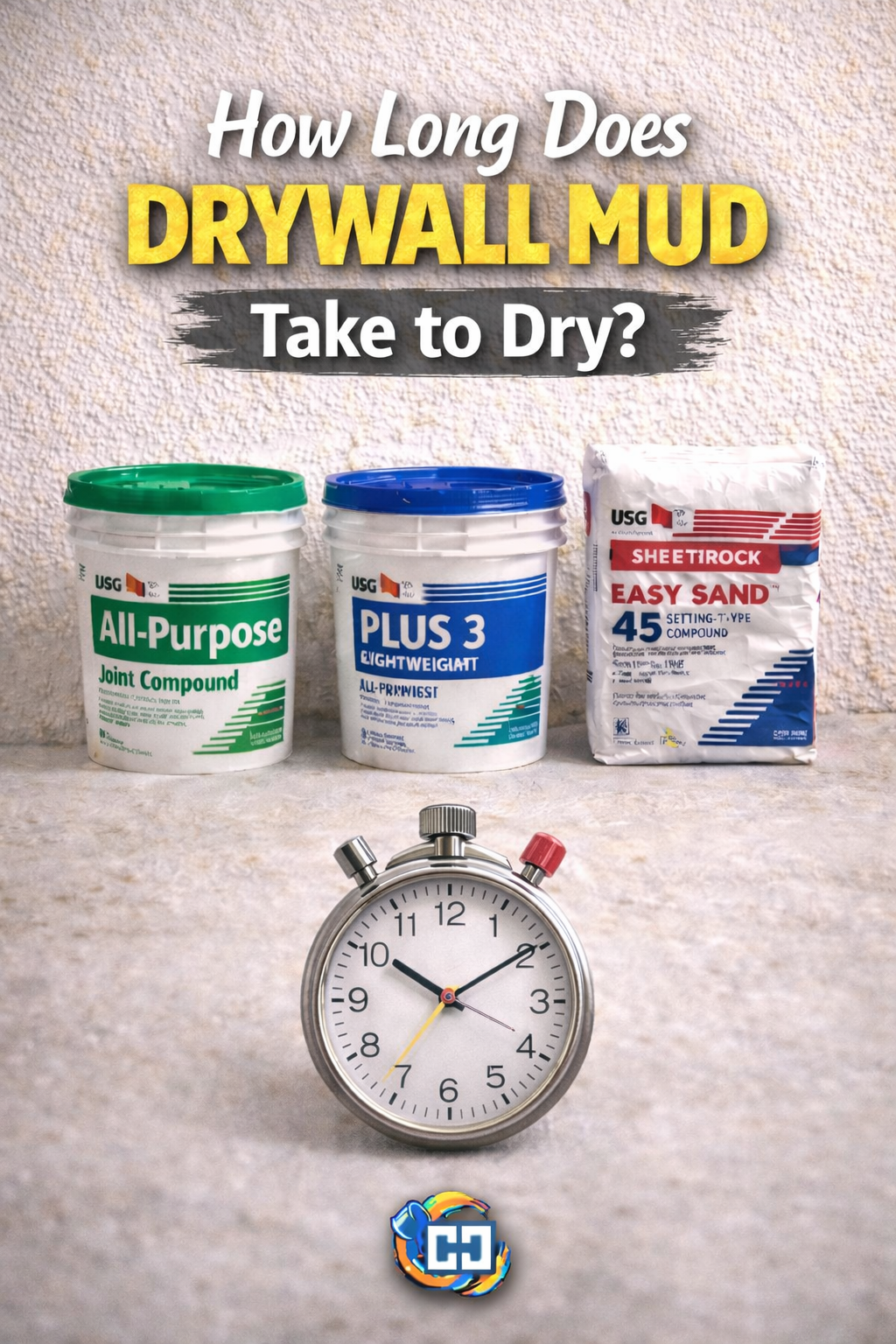
Short Answer: Most drywall mud takes 12 to 24 hours to dry between coats. That depends on the type of compound, thickness of application, temperature of the room, humidity inside and outside, and airflow. If you are in a time crunch, setting-type compounds (hot mud) set much faster than premixed joint compound.
Now let’s break this down in more detail for those who are going to be doing this themselves.
What Type of Mud Are You Using?
Dry time starts with the product.
There are two main categories:
Drying-Type Joint Compound
This includes:
These dry by evaporation.
Typical dry time: 12 to 24 hours per coat.
In humid conditions, it can take longer.
Real-world expectations (thin coats, normal conditions):
- Normal heated house with HVAC running: overnight is safest.
- Basement or high humidity: plan 24+ hours.
- Thick fills: 24 to 48 hours.
- Setting compound: often recoat same day, but still wait until fully dry before priming.
Setting-Type Compound
Often called hot mud.
These are labeled by set times like 20, 45, or 90 minutes.
Important detail:
The number refers to working time, not full dry time.
Setting compound hardens chemically, not by evaporation.
It can usually be recoated in a few hours. Remember, thick areas may still hold moisture and should feel fully hard and dry before sanding or priming.
If you are unsure which compound to use, read:
Spackle vs Joint Compound: What’s the Difference?
Why Is My Drywall Mud Taking So Long to Dry?
Most delays come from one of these:
-
Thick coats
-
High humidity
-
Poor airflow
-
Cold temperatures
In Cleveland basements during summer, humidity alone can double dry time.
Drywall mud likes warm, dry air with movement.
How Thick Was Your Coat?
This matters more than people think. If you can still see some paper texture through the mud, that is usually thin enough. If it looks like cake frosting, it is probably too thick.
Thin coat:
- Dries faster.
- Shrinks less.
- Sands easier.
Thick coat:
- Dries slower.
- Shrinks more.
- Cracks more easily.
If you are applying heavy mud and waiting forever, the issue is not time. It is thickness.
If you need better knife technique, read:
How Do I Choose the Right Drywall Knives?
What Temperature Is Ideal for Drying?
Drywall mud dries best between:
- 60 and 80 degrees Fahrenheit.
- Below 55 degrees, drying slows significantly.
Cold garages and winter remodels often stretch dry times.
If the air feels damp or cool, expect longer waits.
How Does Humidity Affect Dry Time?
Humidity slows evaporation.
High humidity equals longer dry times.
Simple.
If you are working in:
-
A basement
-
A bathroom
-
A house without HVAC running
Dry time increases.
Running a dehumidifier can help significantly.
How Can I Tell If Drywall Mud Is Fully Dry?
Look for:
-
Uniform white color
-
No darker gray areas
-
No cool sensation to the touch
If it feels cool, moisture is still present.
Do not sand or prime until fully dry.
- If you rush sanding, it clogs sandpaper and tears.
- If you rush priming, you risk bubbling or flashing.
If bubbling has been an issue for you, read:
How to Deal with Bubbling or Peeling Paint on Drywall
Can I Speed Up Drywall Mud Dry Time?
Yes, safely.
- Increase airflow.
- Use fans.
- Lower humidity.
Keep temperature consistent.
Do not use direct high heat on fresh mud.
That can cause surface drying while the inside remains wet.
Surface drying too fast can lead to cracking.
Does Setting Compound Dry Faster?
Setting compound hardens faster, but that does not mean it is ready for paint immediately.
You can usually:
Recoat in a few hours.
Sand within the same day.
But full curing still takes time.
Setting compound is great for:
Small patches.
Quick repairs.
Time-sensitive work.
If you are patching drywall and need it to blend properly, read:
How to Fix a Small Hole in Drywall (The Right Way)
What Happens If I Recoat Too Soon?
Common problems:
-
Soft mud underneath
-
Cracking
-
Bubbling
-
Poor adhesion
The second coat traps moisture.
That moisture causes long-term issues.
Patience prevents repairs later.
Can I Paint Over Drywall Mud the Same Day?
Only if:
You used setting compound.
It is fully dry.
It has been sanded properly.
Even then, primer is required.
Never paint directly over unprimed compound.
If you are unsure about blending patches, read:
Can You Use Joint Compound on Painted Drywall?
How Many Coats Does Drywall Usually Need?
Most repairs require:
Three coats.
First coat: embedding or filling.
Second coat: widening.
Third coat: final feather.
Each coat needs proper dry time.
Rushing the process creates more sanding and more frustration.
Why Is My Mud Cracking While Drying?
Cracking usually means:
Coats were too thick.
Mud dried too quickly on the surface.
Movement underneath.
Thin coats solve most cracking issues.
If cracking keeps happening, read:
Drywall Seam Cracks: Why They Happen and How to Fix Them
Final Advice
If you are wondering how long drywall mud takes to dry, plan for 24 hours between coats.
Could it dry sooner?
Sometimes.
Should you count on that?
No.
Drywall finishing rewards patience.
Thin coats.
Full dry time.
Proper airflow.
That combination prevents most sanding and paint problems.
And if you are in Northeast Ohio and need drywall finished cleanly without waiting days between coats, Colin Can Help handles drywall repair and finishing professionally.